
Testing for Australian Standards
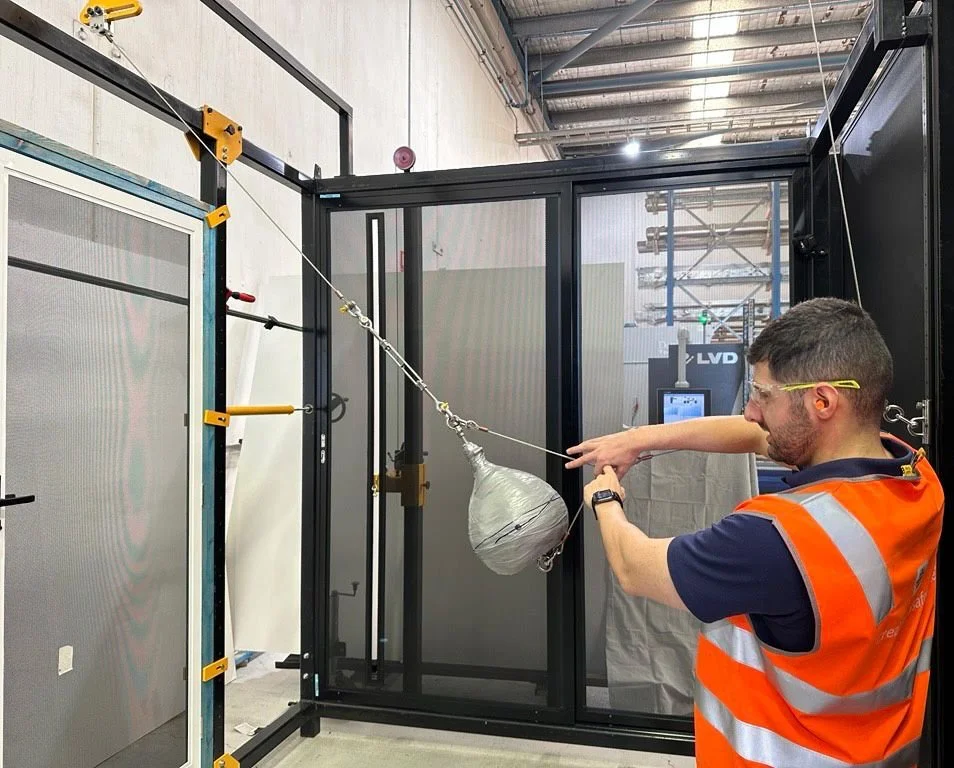
Security screens sold and installed in Australia must meet strict testing procedures to be classified and certified as “security screens.” These procedures ensure screens resist forced entry, resist impacts, provide fire egress where required, and meet durability and corrosion standards for long-term performance in Australian conditions. Below is a clear, detailed rundown of the main tests, what they measure, and how manufacturers and installers demonstrate compliance with Australian Standards (primarily AS 5039, AS 5041 and related requirements).
Standards and regulatory context
AS 5039 Security Screen Doors and Window Grilles — Performance requirements sets out minimum performance levels for security screens. It covers strength, durability, resistance to forced entry, and other performance criteria.
AS 5041 Security Screen Assemblies — Test methods provides the standardised procedures for carrying out the tests specified in AS 5039.
NCC (National Construction Code) and state/local building regulations may reference these standards or require particular classifications for new builds, renovations and fire egress routes.
Products often must be tested by NATA-accredited laboratories and have certification or test reports available for building certifiers, suppliers and consumers.
Primary tests and what they involve
Static load / Ultimate strength test
Purpose: Demonstrates the door or window screen can resist a sustained load without permanent deformation or failure.
Procedure: A concentrated or distributed static load is applied to the screen or frame at specified points (for example on the infill, mesh, frame or hinges). The load is increased until a specified limit or failure occurs.
Acceptance criteria: The assembly must withstand specified loads without breaking or developing fractures, and any permanent deflection must stay within allowable limits.
Impact test (dynamic impact / ram test)
Purpose: Measures resistance to sudden impact and ramming attempts (e.g., an intruder kicking, shoulder-charging or using tools).
Procedure: A mass (pendulum or guided drop weight) is swung or dropped to strike the screen at specified locations (centre, corners, and around lock areas) with defined energy levels. Multiple impacts at progressively higher energies may be applied.
Acceptance criteria: No penetration of the infill or failure of fixings/frame that would allow unauthorised access. Some deformation may be allowed if it doesn’t compromise security.
Cyclic loading / Repeated impact (fatigue) test
Purpose: Tests durability against repeated stresses (simulating long-term use like frequent opening/closing, repeated knocks or impacts).
Procedure: Repeated load cycles or impacts are applied to hinges, locks and the frame over thousands of cycles or specified number of repetitions.
Acceptance criteria: Components must continue to function (hinges operate, locks engage) and structural integrity must be maintained after the test cycles.
Pull-out and shear resistance of fixings and fasteners
Purpose: Ensures screws, rivets, welds and other fixings are secure and won't be pulled or sheared out under attack.
Procedure: Individual fasteners or assemblies are pulled or sheared under controlled load to measure the load required to fail them.
Acceptance criteria: Fixings must resist defined loads and failures must not lead to an access point.
Lock and hardware strength & security testing
Purpose: Confirms that locks, deadbolts, hasps and other hardware meet security performance and are not the weak link.
Procedure: Locks are subjected to torque, pull, impact and manipulation tests. Lock faceplates, strike plates and screw fixings are tested for pull-out and resistance to pry attacks.
Acceptance criteria: Locks must operate correctly after testing and resist forced entry attempts within test parameters.
Tool attack tests (commonly used methods)
Purpose: Simulates common burglary tools (screwdrivers, chisels, hammers, pry bars, drills) to assess how quickly and effectively the screen can be defeated.
Procedure: A sequence of prescribed tool attacks is applied for defined lengths of time at target points (locks, mesh edges, frames).
Acceptance criteria: The assembly must resist penetration for the defined test period and not permit entry within the test conditions.
Mesh tear and puncture resistance
Purpose: Ensures the mesh material and its anchoring resist cutting, tearing or puncturing attempts.
Procedure: Tests include blade, puncture and tear tests on mesh specimens or full assemblies using calibrated loads and tools.
Acceptance criteria: Mesh should resist specified puncture loads and not allow tearing that causes access.
Corrosion resistance / Salt spray test
Purpose: Tests protection of metal components and coatings against corrosion—important for coastal climates around Brisbane and across Australia.
Procedure: Samples (frames, fasteners, hinges) are exposed to neutral salt spray (NSS) for a specified number of hours (commonly 500–1000 hours or more depending
